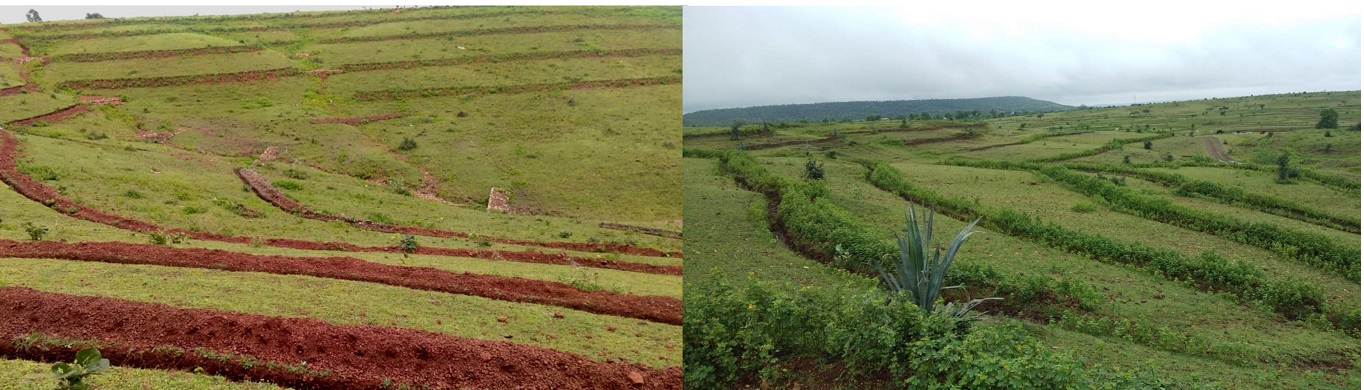
2. Watershed Management (Ecological Resilience)
Early on in its Climate crusade, IFFDC recognised the importance of essentially integrating other thematic interventions like Water Resource Development, Soil Water Conservation, Climate Proofing, Livelihood etc. into this programme for its success.
IFFDC's experience of its watershed management programme for improving gender focused rural livelihoods of communities through natural resource management is in particular noteworthy. It bears repeating that this initiative contributes to the Sustainable Development Goals No. 13 "Climate Action" and SDG 15 “Life on Land” of the United Nations.
In line with its participatory predilection, Village Watershed Committees (VWC) and Water Users Committees (WUC) are developed at grass root level for implementing this programme using a participatory approach. Focusing on providing Water and Food Security, a comprehensive set of activities related to land use planning, development and other livelihood generation activities has been systematically integrated for building up the 'Ecosystem Resilience' of the community.
The purpose of watershed development is to build capabilities of the community to rehabilitate and conserve land and water resources, water being another increasingly threatened resource, in order to develop resilience towards climate change to ensure food and livelihood security. For this, IFFDC has joined hands with other agencies and is mobilising resources directly from NABARD and through convergence with various Government agencies and schemes for the restoration of depleting water resources.
The focus is on land treatment with "Ridge to Valley" treatment concept, climate proofing, livelihood generation and building capacities of the rural community by developing sustainable community institutions like Village Watershed Development Committees (VWDC).
Women being an important part of the water cycle, ensuring gender equity, at all stages of the project cycle is of paramount importance. A total area of 19,568 ha area has been treated by various soil & water conservation measures.
PROJECT DETAILS
|
Supporting Agency |
State |
District |
Treated Area (ha) |
|
NABARD |
Chhattisgarh |
Kawardha, Bilaspur |
2,609 |
|
Madhya Pradesh |
Sagar, Chhindwara, Satna |
4,679 |
|
|
Rajasthan |
Pratapgarh, Udaipur |
1,652 |
|
|
Telangana |
Nizamabad |
1,837 |
|
|
Odisha |
Cuttack |
250 |
|
| Uttarakhand | Nainital | 10 | |
|
State Govt. |
MP (MGNREGA) |
Bhopal, Sheopur, Chhatarpur |
3,417 |
|
MP (IWMP) |
Chhatarpur, Rewa |
5,114 |
|
|
|
Total |
19,568 |
Progress
- 400 ha area has been covered under these initiatives by constructing of 9,239 m3 Farm Bund (FB), 20 m3 Staggered Contour trench (SCT), 65 Loose Boulder Structure (LBS), 202 Stone Outlet (SO), 01 Sunken Pond and 01 Composite Gabion for Soil Water Conservation purpose.
- For harvesting and conserving rain-water, 23 Farm Ponds and 2 Recharge Pits were constructed on farmer fields. The farmers are utilizing the harvested water for irrigating their crops.
- The green cover in the watershed tracts has been increased by planting 3,459 saplings of forestry species and 3,400 saplings of fruit species i.e. Cashew Nut, Plum, Coconut and Mango on Sub-Pasture land. This is helping in the reduction of soil-erosion and mitigating climate change as well as it will help in income generation.
- To increase soil-carbon in arable land, 10 farmers were encouraged to use Bio-decomposer to decompose and convert the crop residues in the field into manure. 5 farmers were helped for the construction of Farm Yard Manure (FYM) Pits to prepare nutrient rich manure. Further, emphasis has also been laid on the cultivation of Dhaincha crop for green manure in 10 farmers’ fields. These activities have helped in increasing carbon content in the soil and enhanced soil fertility.
- To demonstrate and educate farmers about the adoption of chemical free pest control measures on their crops, 30 Insect Trap Solar Lights were installed in their fields. This initiative has greatly helped in restricting the population of harmful insects to below threshold levels.
- Support for setting up of one Flour mill and 2 Grocery Shops has been provided to 3 SHG and 30 Poultry Units (216 Vanaraja breed Chicks in each unit) have been set up for 30 poor families accompanied by feed, feeder boxes and water boxes. This support by IFFDC has helped in offering an alternate livelihood source for them.
- Training on ‘Organic Farming’ has been organized in which 15 farmers participated. The training has initiated them into organic farming practices, which will enable them to secure better prices for their crop-produce.
OUTCOMES OF WATERSHED DEVELOPMENT PROJECTS
- Increase of ground-water and water tables of wells in the project villages has been observed. Farmers are able to harvest a second crop successfully, leading to increased returns.
- Soil-erosion in the watershed area has reduced and additional area has been brought under cultivation, as a result of which the double cropped area as well as cropping intensity has risen.
- Landless farmers and women have been provided employment opportunities in the watershed area through skill development and various soil-moisture conservation activities. There is greater awareness and knowledge of "Climate Smart Agriculture" among the farmers of the project area.
- Enhanced Soil fertility and eco-restoration in the treated area has resulted in the production of good quality fodder for cattle with a consequent improvement in the health of cattle of the area.
- The Project activities have helped in contributing to "More Crop from Each Drop" and "Doubling Farmers Income" objectives of the Govt. of India